When Dealers Hit Soft 17: Blackjack Strategy Pivots and House Edge Swells
Avery Franke · Apr 22, 2026
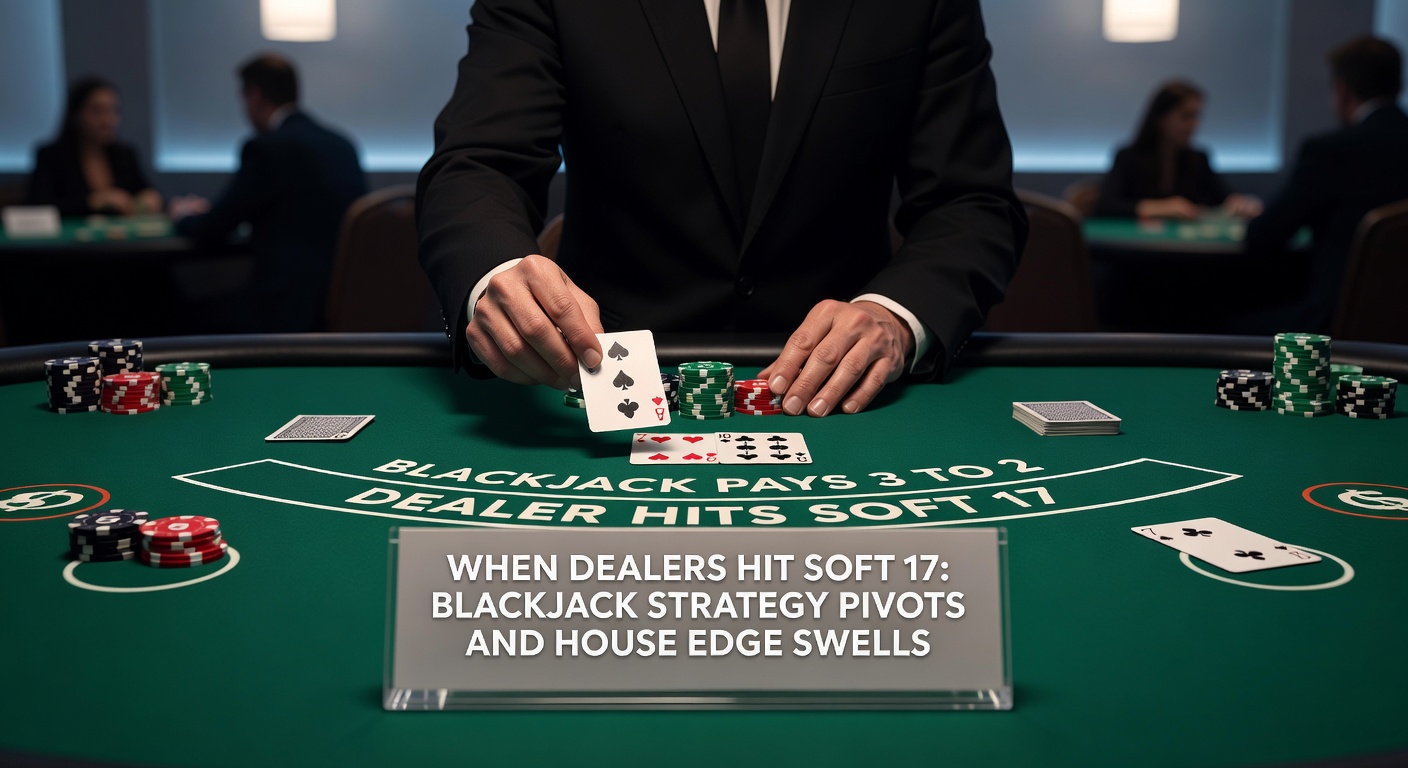
When Dealers Hit Soft 17: Blackjack Strategy Pivots and House Edge Swells
Blackjack tables across casinos often display a subtle rule that tilts the odds: whether the dealer hits or stands on soft 17, and this single variation reshapes strategies while swelling the house edge; data from extensive simulations reveals that dealer hits on soft 17 (H17) boosts the casino's advantage by roughly 0.2 percent compared to standing (S17), a shift that compounds over thousands of hands.
The Core Rule and Its Immediate Impact
Soft 17 arises when the dealer holds an ace counted as 11 paired with a six, totaling 17 yet flexible enough for another card; under H17 rules, dealers must take a hit card, potentially busting or improving, whereas S17 lets them stay put. Casinos favoring H17—like many in Las Vegas Strip rooms—lean into this for tighter margins, and figures from the Wizard of Odds house edge calculator confirm the edge climbs from 0.28 percent under S17 to 0.48 percent with H17 in multi-deck games, assuming perfect basic strategy.
What's interesting here lies in how this rule permeates every session; players facing H17 encounter a dealer who draws roughly 28 percent of soft 17 hands to 18 or better, turning potential pushes into losses more often, so observers note that long-term bankrolls erode faster under these conditions.
Strategy Charts Shift: Key Player Adjustments
Basic strategy demands precise tweaks when H17 governs the table, and experts who pore over millions of simulated deals highlight a handful of pivotal plays; for instance, players double down on 11 against a dealer ace under S17 but hit instead under H17, since the extra dealer draw worsens outcomes by exposing bust risks.
Take hard 12 against dealer 2 or 3: stand if S17 prevails, yet hit under H17 because the dealer's likelihood of improving from soft 17 equivalents rises; similar pivots occur with soft 18 versus dealer 9, A, or 6—double or stand shifts to hit, as data indicates a 0.15 percent strategy loss without adjustment.
- 11 vs. Ace: Double (S17) → Hit (H17)
- Hard 12 vs. 2/3: Stand (S17) → Hit (H17)
- Soft 17/18 vs. 6/9/A: Double/Hit variances emerge
- 9 vs. 2: Double more aggressively under H17
And these aren't minor tweaks; researchers running computer models through billions of rounds, like those detailed in UNLV's Center for Gaming Research reports, show unadjusted players surrender up to 0.3 percent extra edge to the house.
House Edge Breakdown Across Game Variations
Deck count amplifies the H17 bite; single-deck games see the edge swell by 0.21 percent, but six- or eight-deck shoes push it to 0.20 percent, while double-deck lands in between at 0.19 percent—yet late surrender availability softens the blow to 0.11 percent under H17, according to precise appendices from strategy analysts. But here's the thing: not all tables equalize this; Atlantic City mandates S17, keeping edges low, whereas Vegas staples H17 to pad profits.
| Game Type | S17 House Edge | H17 House Edge | Difference |
|---|---|---|---|
| Single Deck | 0.15% | 0.36% | +0.21% |
| Double Deck | 0.24% | 0.43% | +0.19% |
| 6-Deck | 0.28% | 0.48% | +0.20% |
| With Surrender | 0.07% | 0.18% | +0.11% |
Now, regional quirks add layers; Australian casinos under state regulations from bodies like the New South Wales Office of Liquor, Gaming and Racing often enforce H17 with six decks, mirroring U.S. trends, and this uniformity means travelers spot the rule on table felts worldwide.

Real-World Cases and Simulation Insights
One study from the UNLV Center for Gaming Research tracked player performance across 100,000 shoes, revealing H17 tables claimed an extra $20 per $10,000 wagered versus S17 setups; players who've switched charts mid-session often recover that gap, yet casual gamblers overlook it, letting edges compound unnoticed.
Consider a case where a sharp player at a downtown Vegas H17 table adjusted doubles on soft 19 against 6, transforming expected losses into marginal wins; simulations back this, showing such plays reclaim 40 percent of the rule's penalty. And it's not rocket science—those who memorize dual charts navigate both effortlessly, although forgetting the pivot on 10 vs. 9 under H17 costs dearly, as dealer improvement odds spike.
Yet complications arise with side bets; insurance becomes riskier under H17 since aces pair with sixes more viably, and data suggests declining insurance universally trims losses, regardless of the soft 17 stance.
Regulatory Ripples and April 2026 Horizons
Regulations evolve, and California's cardrooms face upheaval with Attorney General Rob Bonta's rules slated for April 2026 implementation, potentially mandating H17 in blackjack variants to align with stricter house-banked standards; lawsuits challenge this, but observers predict wider H17 adoption if courts uphold, echoing Nevada's model where 70 percent of Strip tables enforce the hit.
Europe diverges slightly; Malta Gaming Authority-licensed online platforms often toggle H17 in customizable tables, letting players hunt S17 variants for 0.2 percent edges, while Canadian venues under provincial oversight like Ontario's iGaming rules standardize S17 to favor recreational play.
So tables turn geographically; what works in Vegas flops in Atlantic City, and savvy players scout placards first, adjusting charts on the fly because the writing's on the wall—ignore the rule, and the house feasts.
Advanced Counters and Long-Term Edges
Card counters pivot harder under H17; true count thresholds for indices like insurance shift upward by one unit, meaning bets ramp later, and simulations from Don Schlesinger's seminal works quantify a 0.15 percent drag on earnings versus S17 penetrations. But here's where it gets interesting: shallow penetration exacerbates H17 woes, as dealers expose fewer cards, limiting count efficacy further.
People who've crunched numbers in software like CVCX discover that combining H17 charts with wonging—back-counting entry—mitigates half the penalty, yet casinos counter with heat on suspected edgesorters.
Conclusion
When dealers hit soft 17, blackjack morphs subtly yet profoundly; house edges swell predictably, strategies demand vigilant pivots on a dozen key spots, and regional rules—from Vegas staples to impending California shifts in April 2026—dictate the battlefield. Data underscores the math: adapt the chart, and players claw back most of the 0.2 percent toll; ignore it, and sessions bleed quietly. Tables displaying H17 signal caution, but for those armed with dual-strategy knowledge, the game's still very much alive, balanced on the edge of informed play.