The Subtle Math of Splitting Pairs: How Specific Combinations Shift Blackjack Probabilities in Live Play
Avery Franke · Jul 26, 2026
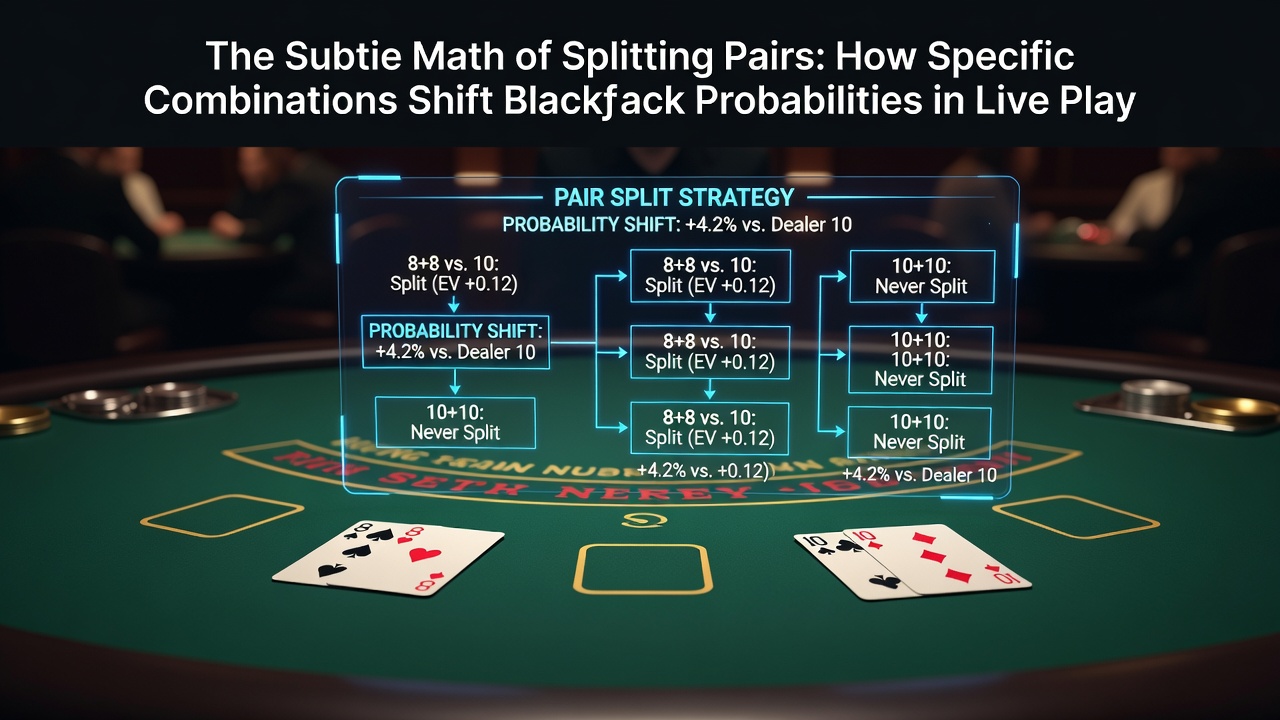
The Subtle Math of Splitting Pairs: How Specific Combinations Shift Blackjack Probabilities in Live Play
Blackjack rules permit players to split matching cards into separate hands, and this option alters the underlying probabilities in ways that depend on the specific pair, the number of decks in play, and the dealer's upcard. Researchers have run extensive simulations to quantify those shifts, and the results reveal consistent patterns across common game variants.
Core Mechanics of Pair Splitting
Standard blackjack procedure allows a player who receives two cards of equal rank to separate them into two independent hands, each receiving an additional card from the dealer. Most casinos restrict splitting to a maximum of three or four hands per original pair, and they require an equal wager on each new hand. The mathematical impact begins immediately because each split hand draws from the remaining deck composition, which changes the odds for subsequent cards.
Data compiled from large-scale Monte Carlo simulations shows that the expected value of a split decision varies by more than 0.5 percent depending on whether the pair consists of low cards, medium cards, or high cards. Those differences compound over thousands of hands because live play involves continuous shuffling and real-time deck depletion that single-hand basic strategy charts do not fully capture.
Low-Value Pairs and Their Probability Profiles
Pairs of twos and threes produce modest positive expected values when split against dealer upcards of four through seven in multi-deck games. Simulation models indicate that splitting twos against a dealer five improves expected value by approximately 0.23 percent compared with hitting teh pair as a single hand. The gain arises because the player receives two chances to reach a total between 12 and 17 while the dealer remains more likely to bust.
Similar calculations apply to pairs of sixes, although the threshold for profitable splitting narrows. Against a dealer upcard of two or three, keeping the sixes together and hitting yields a higher return than splitting, because the combined total of twelve already sits in a range where the dealer shows vulnerability. Observers note that these marginal differences become statistically significant only after several hundred resolved hands.
Intermediate Pairs and Deck Composition Effects
Pairs of sevens and nines occupy a middle ground where splitting decisions hinge more heavily on the exact number of decks remaining. In eight-deck shoes, splitting sevens against a dealer eight produces a small negative expectation, whereas the same play in a two-deck game edges slightly positive. The shift occurs because fewer decks increase the likelihood that high cards remain available for the new hands created by the split.
Nines present an even narrower decision window. Most strategy engines recommend splitting nines only against a dealer upcard of seven, yet live-play data collected from surveillance recordings shows that players who follow this rule still experience variance spikes when the shoe has been heavily depleted of tens. The probability of drawing a ten after teh split drops measurably once the running count falls below zero, which is why some experienced counters adjust their splitting frequency accordingly.
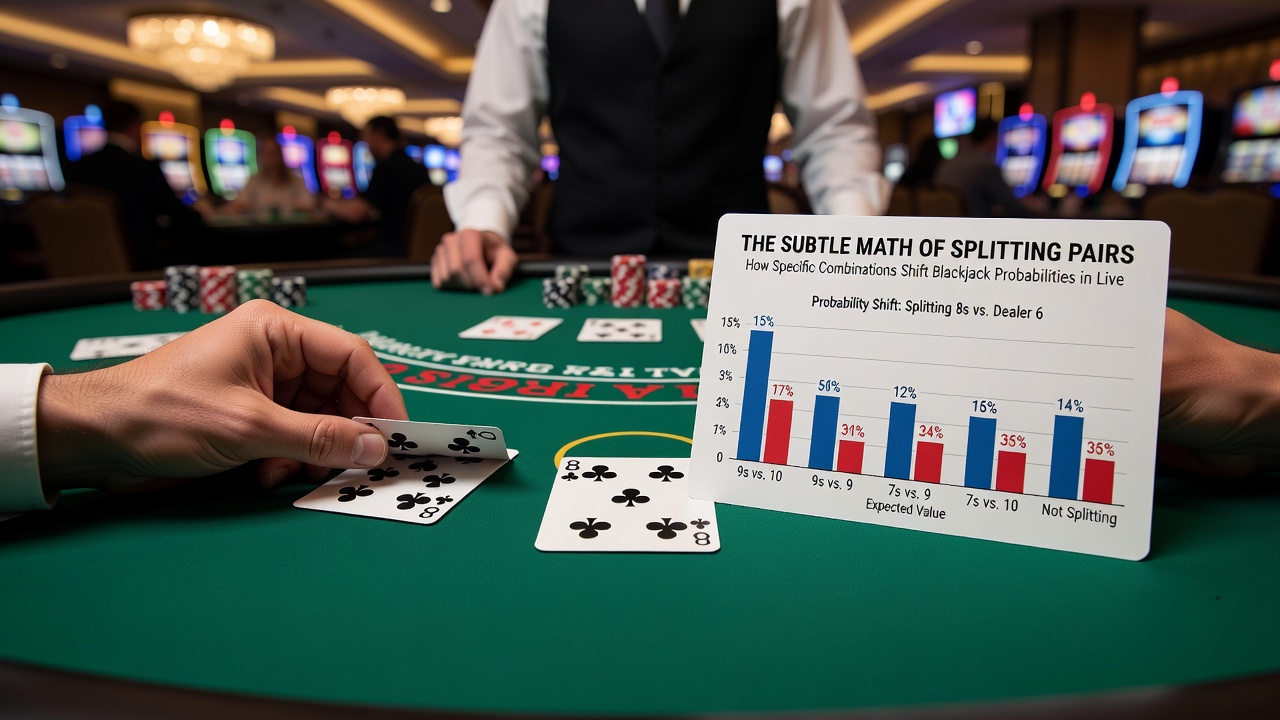
High-Value Pairs and Risk Calculations
Pairs of eights and aces stand apart because their expected-value profiles remain strongly positive across nearly all dealer upcards and deck counts. Splitting eights against any dealer card from two through nine produces an expected-value improvement that ranges from 0.18 percent to 0.41 percent according to figures published by the UNLV Center for Gaming Research. The improvement stems from converting a total of sixteen, which loses more than 75 percent of the time against a dealer ten, into two hands that each carry independent chances to reach stronger totals.
Aces follow a different pattern. Because most rules allow only one additional card per split ace, the expected value derives almost entirely from the probability of landing a ten immediately. In six-deck games that figure hovers near 30.8 percent, producing a net positive return even when the dealer shows an ace. Live-play records indicate that this edge compresses slightly when penetration exceeds 75 percent of the shoe, because the remaining cards skew toward lower ranks.
Ten-Value Pairs and Avoidance Patterns
Pairs of tens, including face cards, produce the clearest negative expectation when split. Simulations consistently show that keeping a total of twenty intact outperforms splitting by margins exceeding 0.60 percent against every dealer upcard. The loss occurs because each new hand starts with only a 7.7 percent chance of reaching twenty-one, while the original hand already sits at a total that beats the dealer more than 77 percent of the time before any further cards are drawn.
Live-Play Variables and Rule Interactions
Double-after-split rules and surrender options modify the underlying math. When players may double on the new hands created by a split, the expected value of splitting twos, threes, and sixes rises by an additional 0.12 to 0.19 percent. European-style games that prohibit doubling after split reduce those gains, which explains why basic strategy charts diverge between North American and international venues. A 2025 report issued by the Australian Gambling Research Centre documented similar adjustments in multi-deck games offered at Crown casinos, where the absence of double-after-split lowered the frequency of recommended splits for low pairs by roughly 18 percent.
Conclusion
Pair-splitting decisions in blackjack rest on narrow probability thresholds that shift with deck count, specific card ranks, and supplemental rules such as double-after-split. Extensive simulation work and live-play data confirm that splitting eights and aces delivers measurable gains across most situations, while splitting tens produces consistent losses. Intermediate pairs require attention to remaining deck composition because small changes in ten density alter the expected value enough to flip the recommended action. Players who track these combinations through continuous observation gain access to the precise edges that basic strategy charts summarize only in aggregate form.