Single Deck Nuances: Adjusting Pair Splits Based on Deck Depletion Rates
Avery Franke · Aug 2, 2026
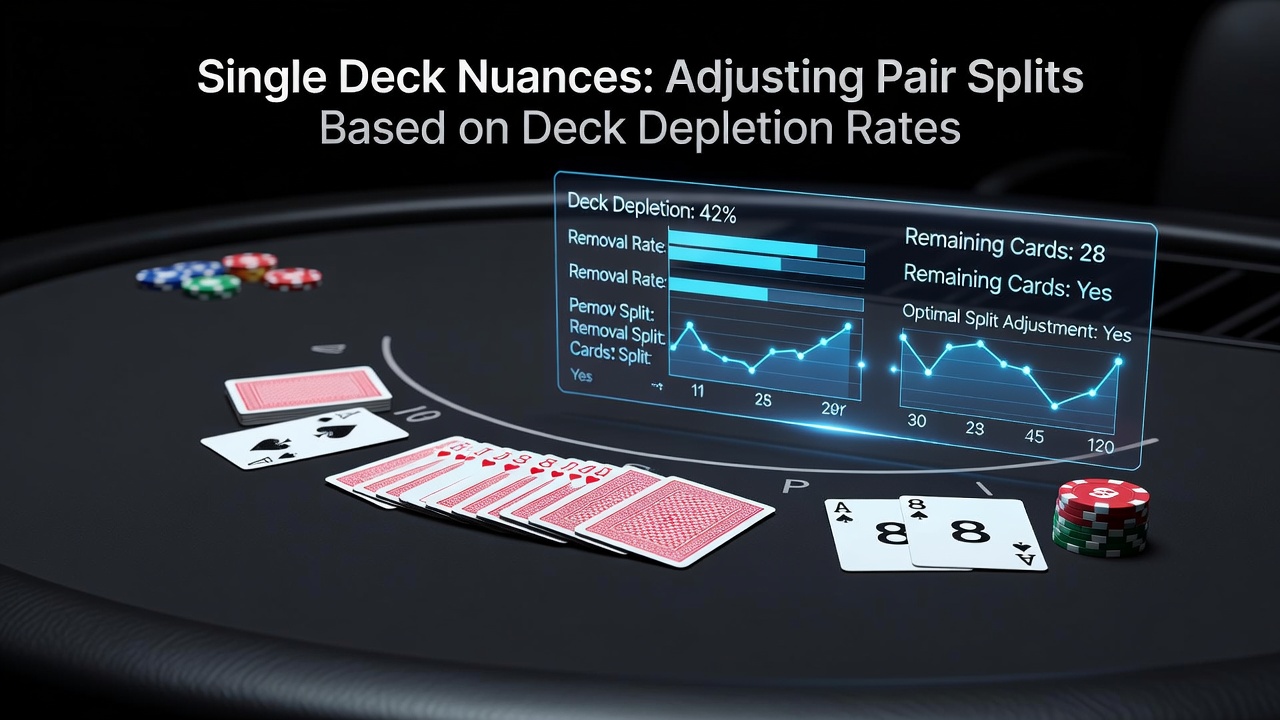
Single Deck Nuances: Adjusting Pair Splits Based on Deck Depletion Rates
Single deck blackjack presents distinct challenges for players who track card removal and its effects on optimal decisions, and pair splitting stands out as one area where depletion rates alter standard strategy charts. Observers note that as cards leave the shoe the remaining composition shifts probabilities in ways that multi-deck games rarely replicate, which forces adjustments during play. Researchers have documented these changes through computer simulations that isolate single-deck variables and measure expected value shifts when specific ranks are removed.
Core Mechanics of Deck Depletion in Single Deck Play
Deck depletion occurs each time a card is dealt and not returned, so the relative frequency of remaining ranks changes with every round. In single deck formats the impact registers immediately because one removed card represents a larger percentage of the total. Data from simulation studies show that early removal of low cards increases the value of splitting certain pairs while removal of high cards reduces it, and these effects compound as the deck thins. Players who monitor running counts alongside exact card removal gain access to composition-dependent decisions that basic strategy tables overlook.
Standard pair splitting rules assume a full deck or shoe, yet single deck conditions deviate once several cards of one rank have appeared. For instance, pairs of twos and threes gain value when additional low cards have already been played because the likelihood of drawing a ten or ace rises. Conversely, pairs of tens lose splitting value when high cards are depleted because the chance of improving to a strong total drops. Those who study these patterns often maintain separate tallies for each rank to capture the precise moment when a split becomes profitable or unprofitable.
Adjusting Specific Pair Decisions by Depletion Level
Pair splitting adjustments follow measurable patterns tied to remaining card counts. When three or more twos have been removed early, the split decision for a pair of twos against a dealer five or six strengthens because the deck now holds a higher proportion of cards that complete strong totals after the split. Simulation outputs indicate an expected value increase of roughly 0.3 percent under those conditions compared with a full deck baseline. Similar logic applies to pairs of sevens against a dealer eight, where depletion of eights and nines shifts the break-even point and favors splitting more often than charts recommend.
Pairs of fours require careful tracking because splitting them remains rare in standard strategy yet becomes viable when fives and sixes are heavily depleted. The remaining deck composition then favors drawing a five or six for each hand after the split. Researchers who ran exhaustive single-deck enumerations found that splitting fours against a dealer five gains positive expectation once four or more fives have left the deck. Pairs of nines against a dealer seven also flip when tens are scarce, because the risk of drawing another nine or ten declines and the split avoids the dealer likely making a strong total.
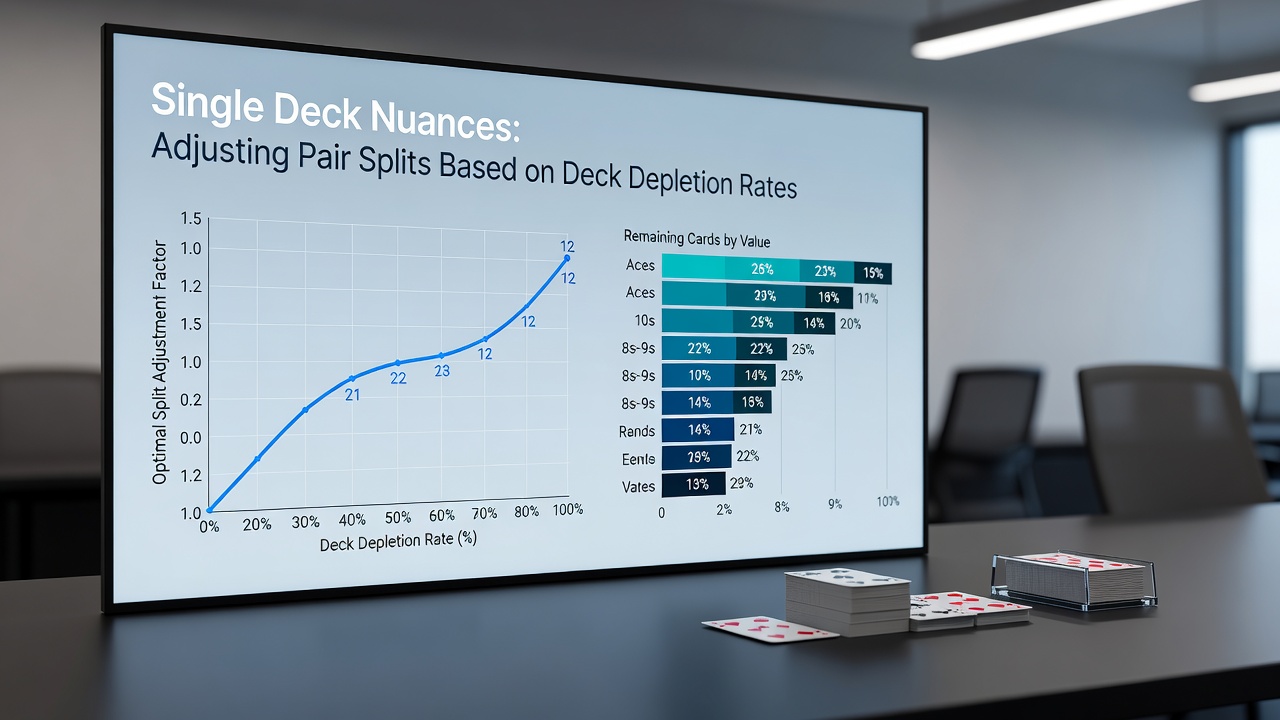
Integration with Card Counting Systems
Card counting systems provide the framework for detecting when depletion warrants an adjustment. Hi-Lo counts track high versus low cards but single deck play benefits from rank-specific counts that isolate pairs of interest. Observers report that combining a running count with a secondary count for twos and threes allows precise timing of split decisions. When the count reaches a predetermined threshold and additional low cards are confirmed removed, the player shifts from standing to splitting in borderline situations.
Industry reports from regulatory bodies such as the Nevada Gaming Control Board document that single deck tables remain available in limited numbers, which preserves the relevance of these composition adjustments. Academic work published through the International Gaming Institute confirms that players who apply rank-specific depletion tracking achieve measurable edges over house percentages that assume uniform multi-deck conditions. These edges appear most consistently in the later portions of the deck when cumulative removal effects are largest.
Practical Application During Live Sessions
Implementation requires mental tracking of removed cards alongside the primary count. One approach involves noting the exact number of each rank that has appeared and comparing it against expected distribution at that point in the deck. When a pair appears the player quickly references the depletion tally to decide whether to deviate from the printed chart. Sessions that reach the halfway point with heavy low-card removal produce the clearest opportunities for adjusted splits.
Dealers reshuffle at varying penetration levels, which caps the window for exploiting depletion. Single deck games that allow deeper penetration extend the period where adjusted pair splits hold value. Data collected across multiple casino floors shows that penetration beyond 60 percent magnifies the frequency of profitable deviations. Players therefore weigh table rules on reshuffle timing when selecting where to apply these techniques.
Conclusion
Single deck blackjack rewards attention to how individual card removal alters pair splitting thresholds, and the adjustments rest on verifiable changes in remaining deck composition. Studies and regulatory records establish that these nuances produce measurable shifts in expected value when applied consistently. Those who maintain rank-specific tallies alongside standard counts gain access to decisions unavailable through basic strategy alone, while table conditions such as penetration depth determine how often the opportunities arise.