Rule Variations Reshape Expected Value in Blackjack Calculations
Logan Jenkins · Jun 10, 2026

Rule Variations Reshape Expected Value in Blackjack Calculations
Blackjack expected value calculations shift whenever casinos alter core rules, and players who track these adjustments gain clearer insight into long-term outcomes. Number of decks, dealer actions on soft totals, doubling restrictions, and surrender options each modify the mathematical edge in measurable ways. Researchers at institutions like the University of Nevada, Reno have documented these effects through extensive simulations that isolate single rule changes while holding others constant.
Deck Count and Its Direct Influence on EV
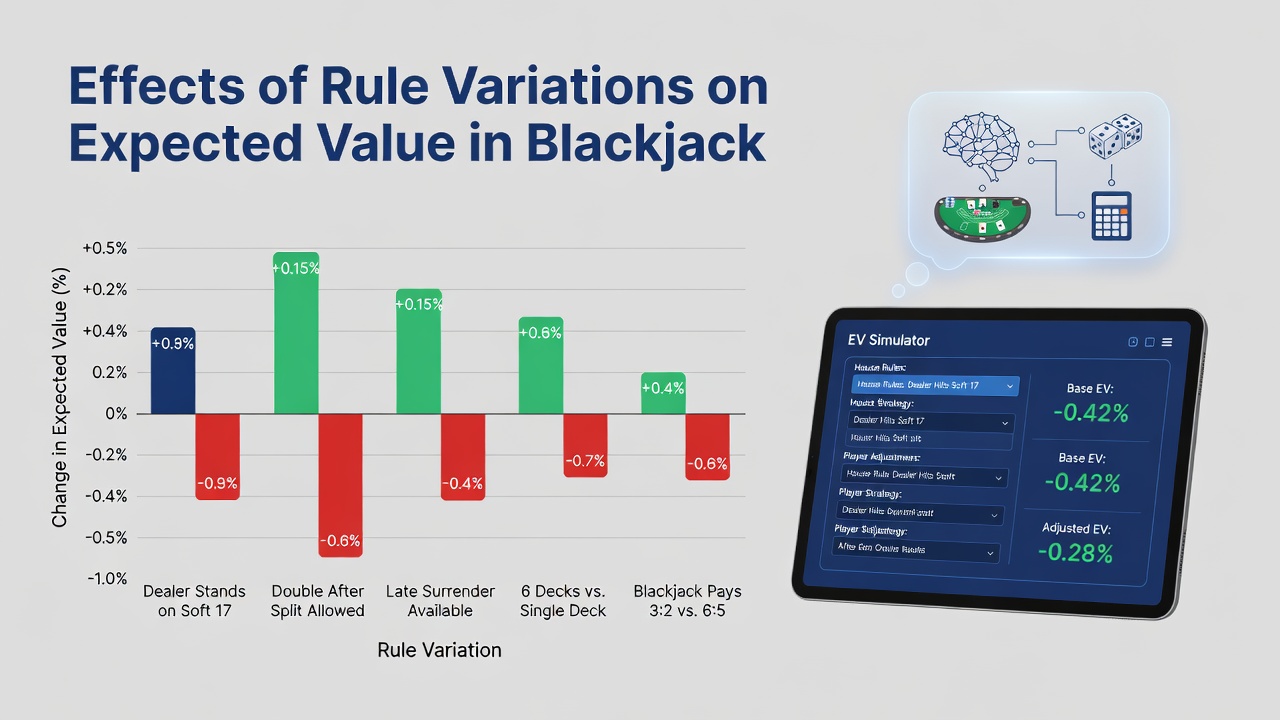
Fewer decks reduce the house advantage because they limit the dilution of high-value cards across multiple rounds, whereas six-deck or eight-deck shoes spread those cards more evenly and slightly elevate the edge. Data from Nevada Gaming Control Board reports show that single-deck games often produce expected values around 0.2 percent better for players than eight-deck equivalents when all other rules remain identical. Observers note that penetration depth interacts with deck count, since deeper penetration in multi-deck games allows card counters to exploit temporary imbalances more effectively than shallow cuts in single-deck formats.
Dealer Standing Rules on Soft Seventeen
When dealers must stand on soft seventeen instead of hitting, player expected value improves by roughly 0.2 percent according to simulation models used across multiple studies. This rule change prevents the dealer from improving certain marginal hands, and the difference compounds over thousands of hands played at a single table. Australian gaming regulators have referenced similar findings in their oversight of local casino operations, where standing rules appear consistently across monitored venues.
Doubling and Splitting Adjustments
Restrictions on doubling after splitting or limits on which totals permit doubling alter expected value by removing high-edge decisions from player strategy. Full doubling on any two cards typically adds between 0.3 and 0.5 percent to player value compared with versions that allow doubling only on nine through eleven. Splitting pairs follows the same pattern, with re-splitting aces or allowing multiple splits increasing favorable outcomes in documented simulations. Those who study these variations find that even small restrictions compound across large sample sizes tracked by regulatory bodies in multiple jurisdictions.
Surrender Mechanics and Late-Game Options
Early surrender, when available, improves expected value more than late surrender because players can forfeit hands before the dealer checks for blackjack. Late surrender still reduces the house edge by about 0.08 percent in standard multi-deck games. European no-hole-card rules interact with surrender decisions, since players lose only the original bet on dealer blackjacks rather than a doubled amount. Canadian provincial reports have tracked these interactions in controlled environments where both rule sets coexist at the same properties.
Combined Rule Sets and Cumulative EV Impact
Real casino offerings combine multiple variations at once, so analysts calculate net expected value by layering each adjustment atop a baseline game. A typical six-deck shoe with dealer hits soft seventeen, double after split allowed, and late surrender produces a house edge near 0.5 percent, while switching the dealer to stand on soft seventeen and adding early surrender drops that figure below zero for skilled players using optimal strategy. European Blackjack Association publications compile these layered calculations across dozens of rule combinations reported by member casinos.
Practical Measurement Through Simulation
Modern expected value assessments rely on billions of simulated hands rather than small live samples, allowing precise isolation of each rule's contribution. Software that enforces exact payout structures and shuffle algorithms produces repeatable results that match theoretical models within narrow margins. Gaming laboratories in several countries validate these tools before casinos adopt new rule configurations, ensuring published house edges reflect actual play conditions.
Conclusion
Rule variations continue to define the mathematical landscape of blackjack because each change modifies the probabilities that underpin every decision. Players and analysts who examine deck counts, dealer actions, doubling limits, and surrender options obtain accurate expected value figures that reflect the specific game on offer. Regulatory data from diverse regions and academic simulations together confirm that these adjustments remain measurable and predictable across different casino environments.