Reshaping Odds: The Effect of Shuffle Machines on Blackjack Hand Outcomes
Devon Schmid · Jun 12, 2026

Reshaping Odds: The Effect of Shuffle Machines on Blackjack Hand Outcomes
Automatic shuffle machines have altered the pace and structure of blackjack tables across casinos worldwide since their wider introduction in the late 1990s and early 2000s, according to industry reports from the American Gaming Association. These devices range from batch shufflers that randomize a single deck or shoe between rounds to continuous shuffle machines that return cards to the mix almost immediately after each hand. Observers note that such equipment changes both the speed of play and the mathematical distribution of outcomes compared with traditional hand shuffling.
Mechanics of Modern Shuffle Equipment
Batch shufflers accept a set of cards after a round concludes, mix them through a series of rollers and compartments, then dispense a freshly randomized pack within seconds. Continuous shuffle machines, often called CSMs, operate differently by feeding used cards back into an active reservoir while the dealer continues to pull from the same device. Researchers at the University of Nevada, Las Vegas International Gaming Institute have documented that CSMs maintain a near-constant state of randomization throughout a shift, which reduces the window for any sequential tracking. Data from casino operations in Nevada and New Jersey indicate that these machines increase the number of hands dealt per hour by 20 to 30 percent when compared with manual shuffling procedures.
Impact on Card Sequencing and Tracking
Traditional blackjack analysis relies on remaining card composition within a finite shoe, yet shuffle machines compress that window dramatically. When a CSM returns cards to the mix after every hand, the effective penetration drops to near zero, which eliminates opportunities to adjust bets based on prior results. Studies compiled by the Nevada Gaming Control Board show that tables using CSMs produce outcome distributions closer to theoretical probabilities over shorter time spans because each round draws from a freshly randomized pool. In contrast, hand-shuffled games allow for measurable deviations during deeper penetration, though those deviations require sustained observation across multiple decks.
Statistical Effects on Player and Dealer Results
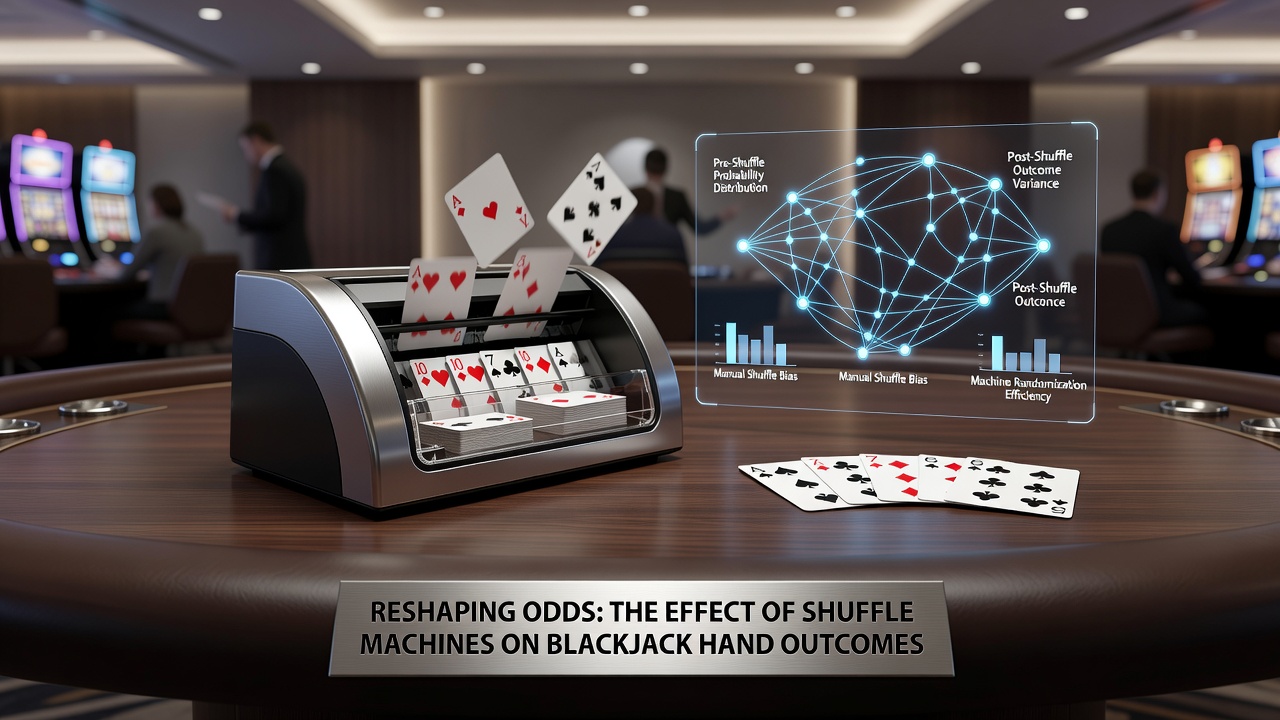
Mathematical models published in gaming research journals demonstrate that the house edge on standard blackjack rules remains unchanged by shuffle equipment alone, yet the variance experienced by individual players shifts because fewer cards leave the active deck. One analysis of multi-deck games found that CSM tables generate slightly tighter clustering around expected values across large sample sizes, simply because the randomization cycle resets more frequently. Figures released by the Australian Gambling Research Centre reveal similar patterns in jurisdictions that permit both machine and manual shuffling, with no measurable change in overall return-to-player percentages but noticeable differences in session-length volatility.
Operational Changes Across Jurisdictions
Casinos in Macau and Singapore adopted continuous shuffle technology on many tables during the 2010s expansion of integrated resorts, while some European venues retained hand shuffling for lower-limit games. Regulatory filings from the Alcohol and Gaming Commission of Ontario indicate that shuffle machine approvals require independent testing for randomness compliance before deployment. Those who've examined operational logs across multiple properties report that dealers spend less time on shuffling tasks, which allows tables to accommodate more players during peak hours without extending shift lengths.
Long-Term Observations from Gaming Data
Longitudinal records maintained by state gaming agencies show that the proportion of blackjack tables equipped with automatic shufflers has risen steadily since 2015, particularly in high-volume markets. This trend coincides with increased hand counts per table but does not alter the fundamental probabilities attached to individual card combinations. Experts monitoring these systems emphasize that outcomes remain governed by the same rules of the game, regardless of whether cards arrive from a machine or a dealer’s hands, provided the device meets certified randomness standards.
Conclusion
Shuffle machines continue to influence table dynamics by accelerating rounds and limiting sequential information available during play. Available data from regulatory bodies adn academic sources confirm that these devices standardize randomization without modifying core game mathematics, which keeps blackjack outcomes aligned with established probabilities across both machine-assisted and traditional formats.