Precision in Pairs: How Blackjack's Splitting Mechanics Cascade Through Multi-Deck Probabilities
Devon Schmid · May 29, 2026
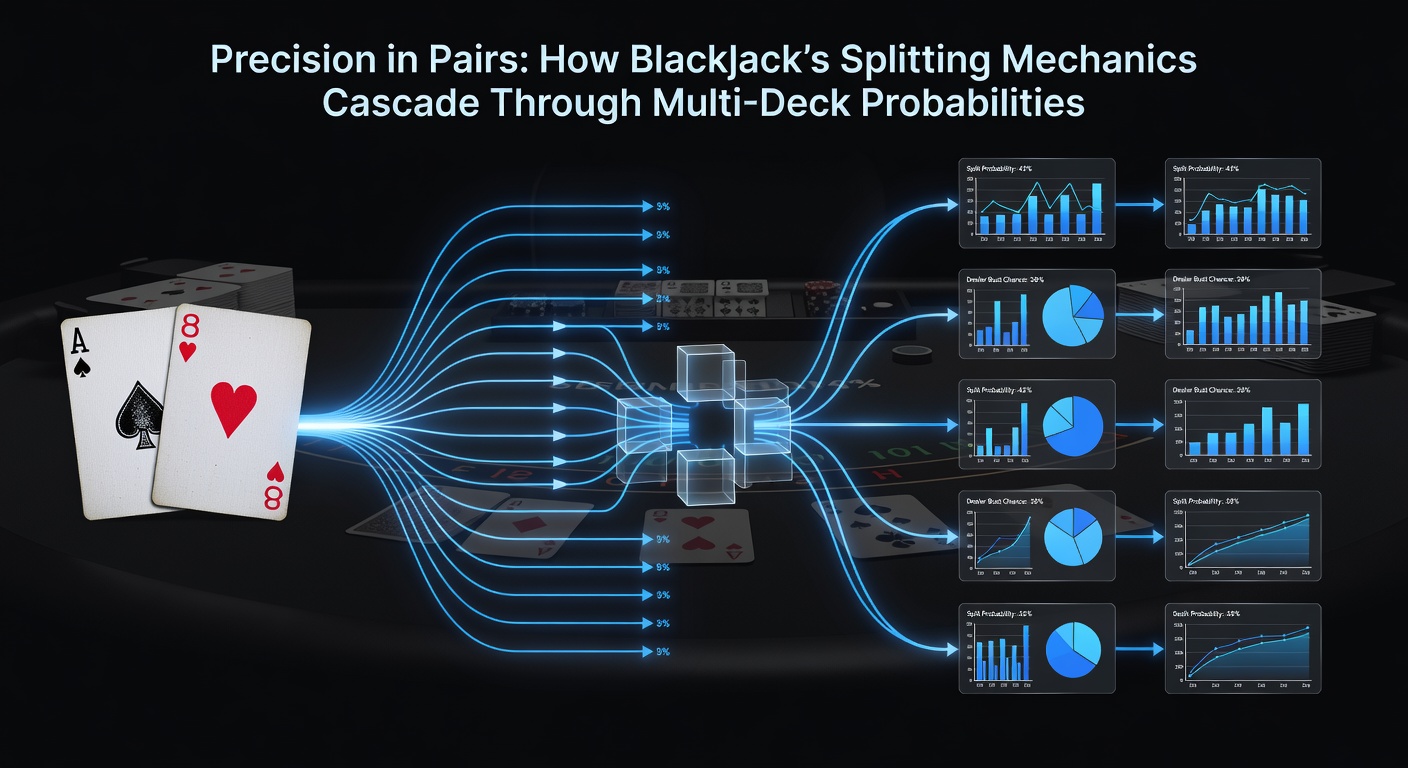
Precision in Pairs: How Blackjack's Splitting Mechanics Cascade Through Multi-Deck Probabilities
Blackjack splitting mechanics create layered decision trees that shift expected values across multi-deck configurations, and researchers track these shifts through detailed combinatorial analysis rather than simple single-hand calculations. When players split pairs the original wager duplicates while new hands form independent paths, each subject to the same dealer rules yet drawing from a shared shoe that depletes differently with every additional card. Data from multi-deck simulations show that splitting choices alter the overall house edge by fractions of a percent, yet those fractions accumulate across thousands of hands played in continuous-shuffle or shoe-based formats.
Core Rules Governing Pair Splits
Standard rules permit a split whenever a player receives two cards of identical rank, after which each new hand receives one additional card and proceeds independently unless further pairs appear. Most casinos restrict resplitting to a maximum of three or four hands per original wager, while aces typically receive only one card each and prohibit further splits. These constraints interact directly with deck penetration levels because deeper penetration exposes more precise remaining-card counts that influence whether a second split improves or reduces overall return.
Multi-deck games commonly use six or eight decks shuffled together, and the increased card pool dampens the impact of any single split compared with single-deck play. Observers note that the probability of receiving a ten-value card after splitting eights, for example, remains statistically stable across the larger deck, yet cumulative effects emerge once multiple splits occur within the same shoe.
How Splitting Cascades Through Probability Layers
Each split initiates a branching sequence where subsequent draws modify the composition of the remaining deck for every other player at the table as well as the dealer. Research indicates that splitting a pair of sevens against a dealer six creates two hands whose combined expected value exceeds the original unsplit hand, yet the second hand draws from a deck now missing one seven and one six. That depletion cascades forward because the next round begins with slightly altered frequencies that compound when penetration reaches 60 or 70 percent of the shoe.
Figures from probability models reveal that repeated splitting opportunities, particularly with low-value pairs, increase the number of decisions per round and therefore magnify the effect of any deviation from basic strategy. When players split twos or threes against a dealer four, the additional hands generate more hits that remove small cards from circulation, which in turn raises the proportion of high cards available for later rounds. Those shifts remain modest in isolation but become measurable once tracking software aggregates millions of simulated shoes.
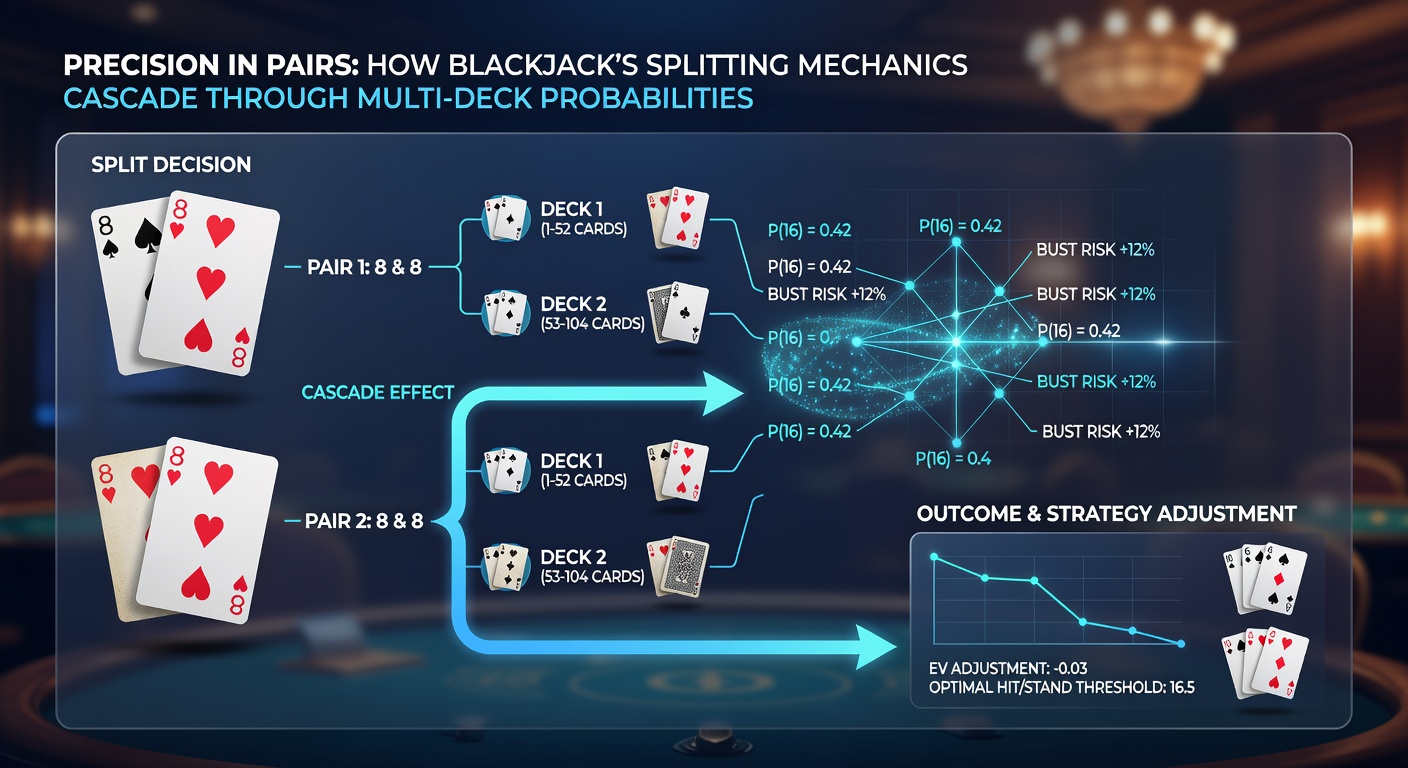
Multi-Deck Specific Effects on Common Splits
Basic strategy charts calibrated for six-deck games advise splitting aces against every dealer upcard except an ace, while eight pairs warrant splits against dealer two through seven. Eight-deck variants produce nearly identical recommendations, yet the slightly lower volatility in card distribution means the edge gained or lost from each split registers in smaller increments. Studies compiled by academic gaming programs demonstrate that the return difference between six-deck and eight-deck splitting matrices stays under 0.05 percent when rules remain constant, although that gap widens when surrender options or dealer hit-soft-seventeen rules enter the equation.
Pair of nines against a dealer seven presents a borderline case where splitting yields a marginal improvement in six-deck play but a negligible one in eight-deck configurations. Analysts attribute the difference to the greater density of ten-value cards that remain after the initial split removes two nines, an effect diluted across more total cards. Players who track running counts can adjust these baseline decisions because true-count thresholds alter the point at which splitting tens becomes advantageous, a scenario rare yet mathematically documented in high-count situations.
Measurement Tools and Data Sources
Combinatorial calculators and Monte Carlo simulations serve as primary instruments for quantifying cascade effects, and organizations such as the Nevada Gaming Control Board publish aggregated return data that reflect real-world multi-deck conditions. Additional insight emerges from reports issued by the Australian Gambling Research Centre, which examines how splitting frequency interacts with table minimums and penetration limits across regional markets. These sources supply empirical benchmarks that theoretical models then refine for specific rule sets.
Conclusion
Splitting mechanics in multi-deck blackjack therefore function as interconnected variables whose individual contributions multiply through successive rounds and shared deck states. Precise measurement requires attention to both the immediate expected-value change per split and the downstream composition shifts that affect every subsequent hand. Regulatory updates scheduled for May 2026 in several jurisdictions may further standardize reporting of these probability layers, yet the underlying mathematics remain consistent across current six-deck and eight-deck environments.