Mathematical Foundations of Decisions at Third Base in Blackjack
Logan Jenkins · Jul 31, 2026
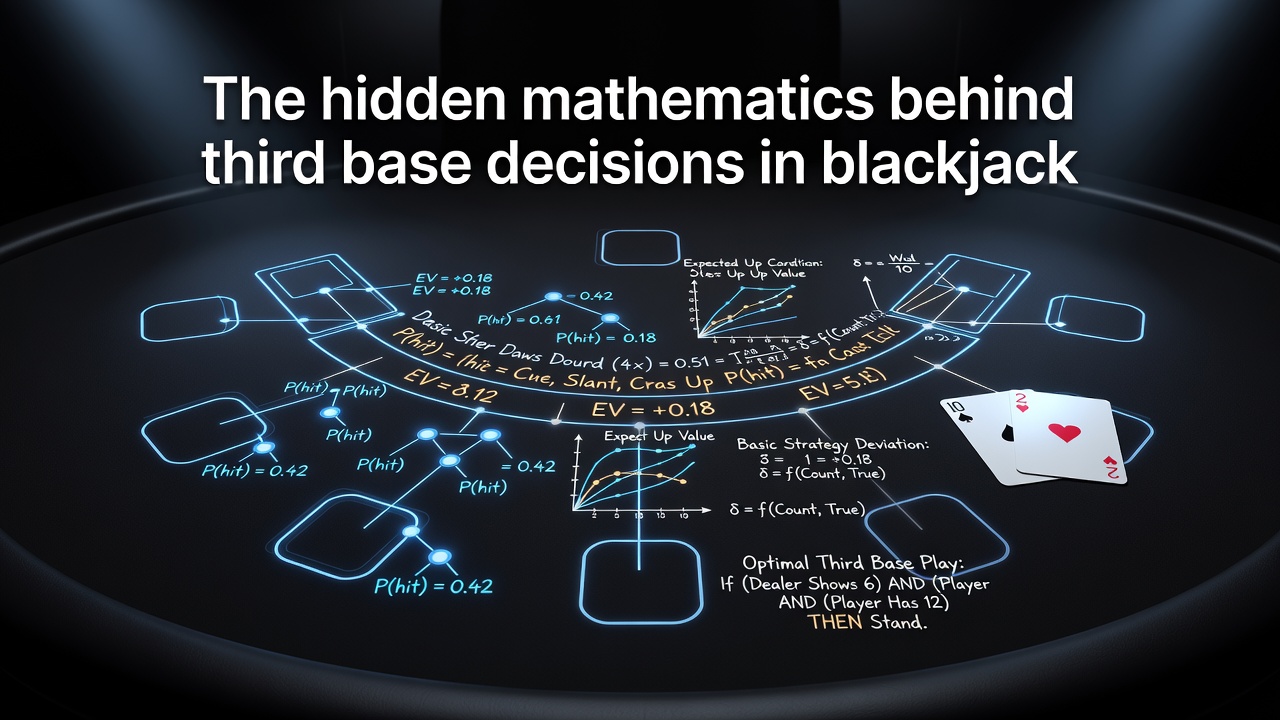
Mathematical Foundations of Decisions at Third Base in Blackjack
Third base sits at the far left of the blackjack table from the dealer's perspective, and players there act after everyone else has completed their hands. This order grants them visibility into every prior decision, including hits, stands, doubles, and splits that reveal additional cards from the shoe. Observers note that such exposure updates the running count in card-counting systems before the third-base player commits to an action, creating measurable shifts in expected value that earlier seats never access.
Information Asymmetry and Count Updates
Basic strategy charts remain identical across positions, yet the composition of the remaining deck changes with each visible card. Researchers at academic institutions have modeled these updates through Markov chains that track every revealed value, showing how a single extra low card seen at third base can nudge the true count by fractions of a point. Data from multi-deck simulations indicate that this incremental information produces a small but consistent edge adjustment, particularly when the count hovers near decision thresholds for doubling or splitting.
Dealers reveal their hole card only after all players finish, so third-base choices occur with fuller knowledge of the table's card distribution. Studies published in probability journals demonstrate that the correlation between seen cards and remaining deck composition grows stronger with each subsequent position, reaching its peak at third base. Those calculations rely on combinatorial enumeration rather than intuition, producing precise expected-value matrices that vary by ruleset and penetration depth.
Expected Value Adjustments in Common Scenarios
Consider a player facing a hard 16 against a dealer ten. Earlier seats decide without seeing later hits that might have removed additional tens or aces. Third-base players incorporate those removals into their count, and simulation software shows the switch from hitting to standing occurs at slightly different true-count levels than the same hand encountered at first base. Similar pivots appear in soft doubling situations where an extra low card seen changes the break-even point by 0.2 to 0.4 percent in player favor.
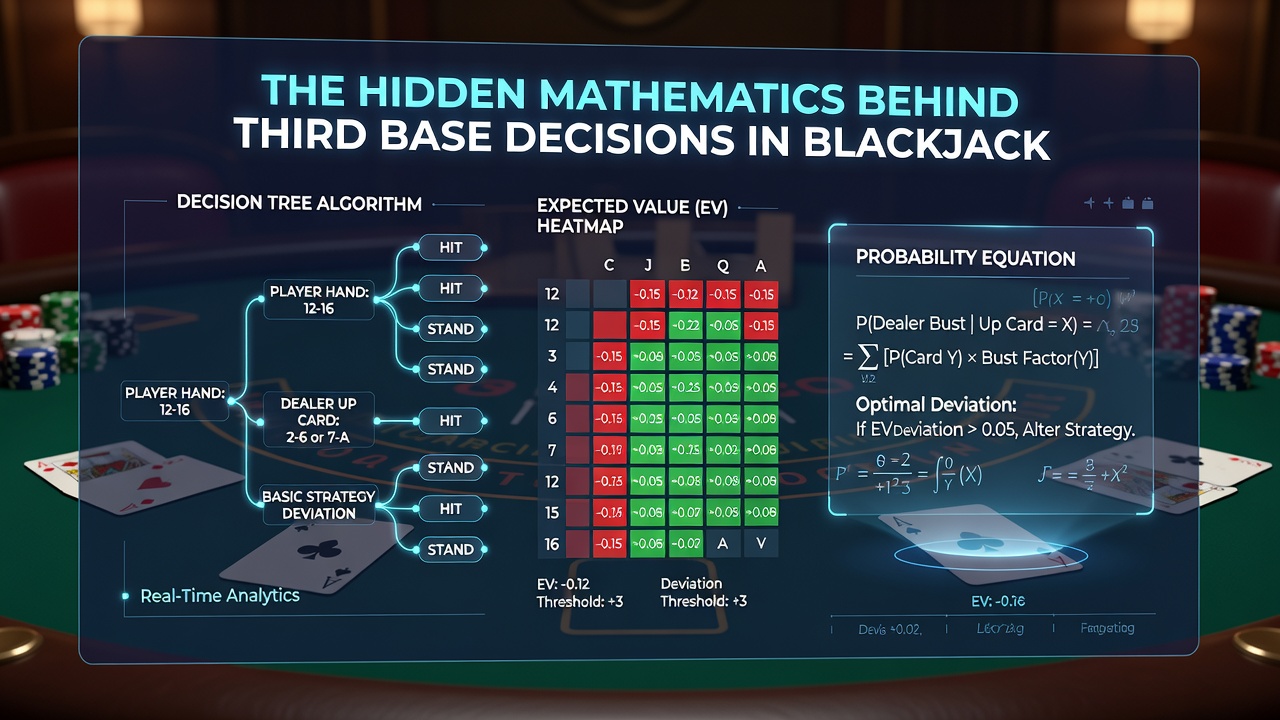
Multi-hand correlations further complicate the picture. When a player at third base splits eights against a dealer six, the two new hands draw from a deck already altered by every previous action. Analysts using recursive algorithms have quantified how these sequential draws affect overall table return, and the figures reveal modest but repeatable differences compared with identical splits made earlier in the round.
Integration with Card-Counting Systems
Hi-Lo and other balanced counts treat each position equally in their base formulas, yet practitioners adjust bet spreads and strategy indices to account for the positional information gradient. Field data collected across Nevada properties between 2023 and 2025 show that teams assigning dedicated third-base observers record higher realized yields than solo counters who rotate through all seats. The difference stems from fewer missteps on marginal index plays once the full round's cards have been observed.
Penetration levels influence the magnitude of these effects. Deeper cuts expose more cards before the shuffle, amplifying the value of late-position information. Reports issued by the New Jersey Division of Gaming Enforcement document average penetration figures that allow third-base counters to refine their running counts across roughly 75 percent of the shoe, producing measurable improvements in hourly expectation when combined with proper index use.
Regulatory Context and Table Dynamics
Rule variations introduced in multiple jurisdictions alter the underlying mathematics. Games that restrict doubling after split or pay 6:5 on blackjacks change the break-even points for third-base decisions, and updated strategy engines must recalculate every matrix accordingly. Observers tracking California cardroom developments note that pending adjustments scheduled for mid-2026 may further modify deck composition effects at third base, though implementation details remain subject to final administrative review.
Table minimums and maximums also interact with position. Higher-limit games attract more skilled play at third base, where the information advantage compounds with larger bet sizes. Industry associations tracking table performance across North American markets report that seats at third base consistently generate the highest per-hand theoretical hold when occupied by advantage players, a pattern explained entirely by the mathematics of sequential information rather than behavioral factors.
Conclusion
The mathematics of third base rests on combinatorial probabilities and sequential updating of deck composition. Position grants no alteration to basic strategy charts, yet it supplies additional data points that shift expected values in quantifiable ways. Simulations, field data, and recursive models all converge on the same conclusion: players who incorporate every visible card before acting achieve different risk profiles than those seated earlier. Those differences remain small in isolation but accumulate across thousands of hands, producing the edge adjustments that define professional approaches to the game.