Insurance Bets Unpacked: Blackjack's Side Wager Mechanics and Their Precise Thresholds
Avery Franke · Jul 15, 2026
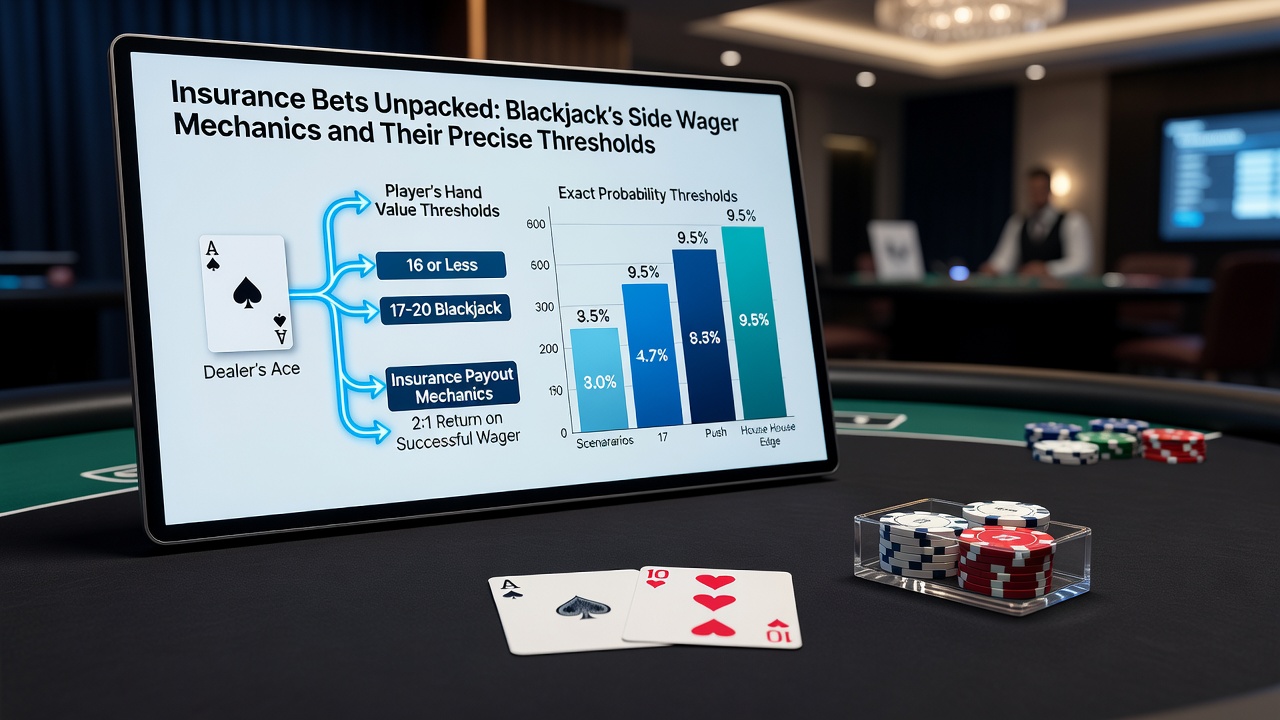
Insurance Bets Unpacked: Blackjack's Side Wager Mechanics and Their Precise Thresholds
Insurance bets function as a side wager that activates whenever the dealer reveals an ace as the upcard, allowing players to protect against the possibility of a dealer blackjack. The option appears before the dealer checks the hole card, and participants may wager up to half their original bet on whether the dealer holds a ten-value card underneath. Payouts occur at 2 to 1 when the insurance succeeds, yet the underlying probabilities demand careful scrutiny because the wager carries its own independent house edge under standard rules. Mechanics begin with the dealer announcing the insurance opportunity and collecting bets from those who participate. Once all insurance wagers are placed, the dealer peeks at the hole card using a mirror or electronic sensor in most modern casinos. A ten-value card confirms blackjack, insurance bets win, and play on the main hand usually ends for those positions. When the hole card proves otherwise, insurance loses immediately while the round continues with normal play. Precise thresholds for positive expectation hinge on the ratio of remaining ten-value cards to the total undealt cards. The break-even point sits at one third, meaning insurance becomes mathematically advantageous only when ten-value cards comprise at least 33.33 percent of the remaining deck. In a single-deck game this threshold translates to roughly thirteen tens left among thirty-nine unseen cards after the initial deal. Multi-deck shoes require proportionally higher ten counts because the larger card pool dilutes the impact of any single ten. Card counters track this ratio through systems that assign values to tens and aces, adjusting running counts accordingly. When the true count climbs above approximately +3 in a typical six-deck shoe, the insurance correlation strengthens enough to justify the side bet even for players following basic strategy deviations. Observers note that many tables now employ continuous shuffle machines that reset the deck frequently, which flattens these count-based opportunities and keeps insurance firmly negative for everyone. Data from regulatory filings show that insurance participation rates hover near 15 percent across monitored Nevada properties, yet win percentages for the house on this wager exceed 7 percent on average when players accept the bet indiscriminately. According to the Nevada Gaming Control Board annual reports, side wager revenue including insurance contributes measurable portions to table game hold percentages without requiring changes to core blackjack rules. Research from academic sources such as the University of Nevada, Reno gaming studies indicates that precise insurance thresholds shift slightly under rule variations like dealer hits on soft 17 or limitations on double-down options. These adjustments alter deck composition dynamics enough to move the optimal insurance point by fractions of a percent, though the one-third benchmark remains the foundational reference point taught in most probability courses. Players who attempt insurance without tracking tens encounter consistent negative expectation because the initial two-card distribution favors the dealer holding a ten only about 30.8 percent of the time in fresh multi-deck shoes. That figure climbs when earlier rounds have removed low cards, creating the windows counters exploit. Those windows close quickly once the shoe penetrates past 50 percent, a condition common in venues that limit deck exposure to control advantage play. 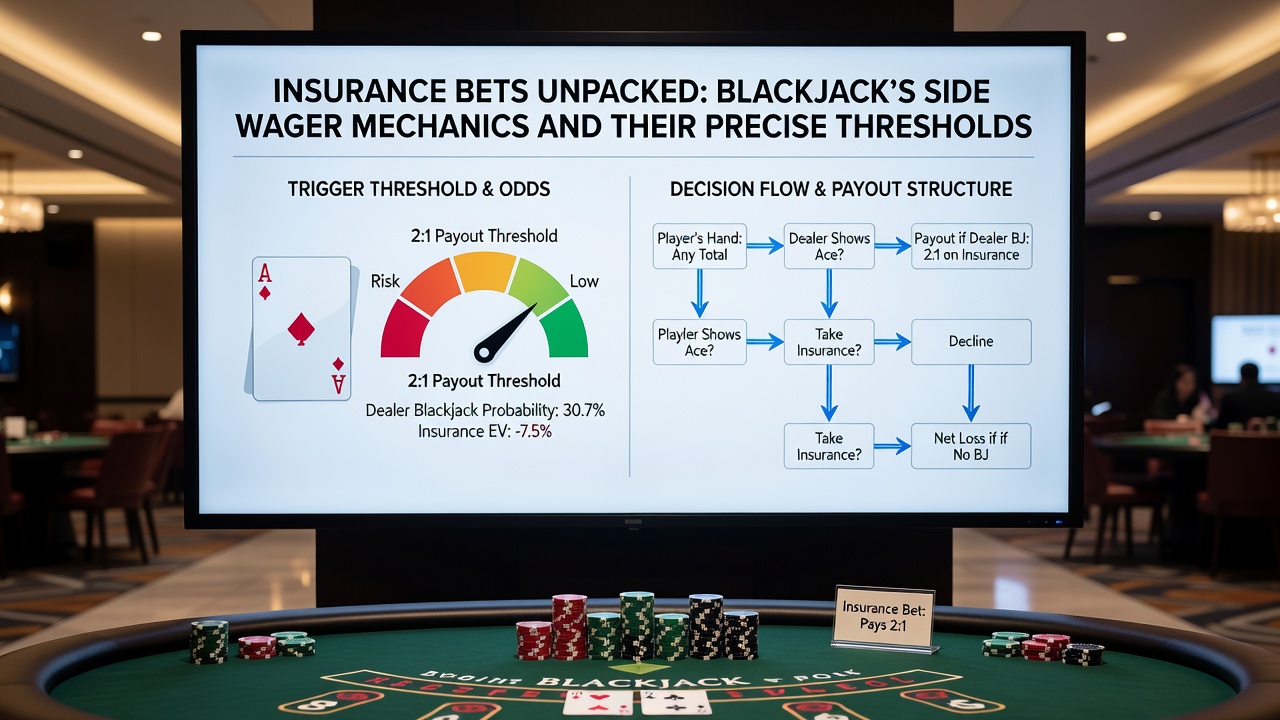 Additional considerations arise in games that offer even-money payouts on player blackjacks when the dealer shows an ace. Accepting even money effectively mirrors the insurance bet outcome without placing a separate wager, yet the decision still rests on the same ten-value proportion. Australian regulatory summaries from state gaming authorities document similar insurance mechanics in local casinos, confirming that payout structures align closely with North American standards despite differing tax frameworks. Tournament formats sometimes restrict or eliminate insurance entirely to maintain pace and reduce variance among competitors. Organizers cite simplified rule sets that prevent side bet complications from influencing final standings. Such restrictions appear more frequently in events scheduled for mid-2026 across multiple jurisdictions, where focus remains on core hand resolution rather than ancillary wagers. Equipment variations further influence threshold calculations. Automatic shufflers and continuous shuffle devices reduce the window during which ten-rich segments remain available, effectively erasing count advantages before they accumulate. Casinos adopting these machines report stable hold percentages on insurance across all player types because the side bet reverts to its baseline negative expectation. Training materials distributed by industry groups emphasize that insurance functions independently of basic strategy charts, requiring separate memorization of the count correlation. Those charts list insurance as a deviation only after the true count justifies the wager, underscoring how the side bet demands real-time deck composition awareness rather than fixed responses.