Inside the Math: How Split Decisions Alter Blackjack Probabilities in Multi-Deck Games
Devon Schröder · May 27, 2026

Inside the Math: How Split Decisions Alter Blackjack Probabilities in Multi-Deck Games
Pair splitting ranks among the most influential decisions in blackjack because it transforms a single hand into two separate wagers while shifting the underlying probability distribution for each new starting point, and in multi-deck formats that change becomes measurable through combinatorial enumeration and large-scale simulation models.
Core Mechanics of Splitting in Shoe Games
Multi-deck games typically use six or eight decks shuffled together, which reduces the impact of any single card removal compared with single-deck play yet still leaves room for splitting to alter expected value, and researchers calculate those shifts by enumerating every possible draw sequence after the initial pair is separated. When a player splits a pair the original wager doubles, two new hands form, and each proceeds independently according to the same rules that govern all other hands, so the overall return depends on how often each new hand wins, pushes, or loses against the dealer’s final total.
Probability Adjustments for Common Pairs
Data from simulation studies show that splitting eights against a dealer’s six produces a positive expected value in eight-deck games because the dealer busts at a higher rate while the player’s two new hands each start from a strong total of eight; conversely, splitting tens against any dealer upcard lowers the long-run return because the player forgoes a high-probability standing hand of twenty. Splitting aces receives only one additional card per new hand under most rulesets, which caps upside potential yet still improves results over standing on a soft twelve or thirteen when the dealer shows a weak upcard.
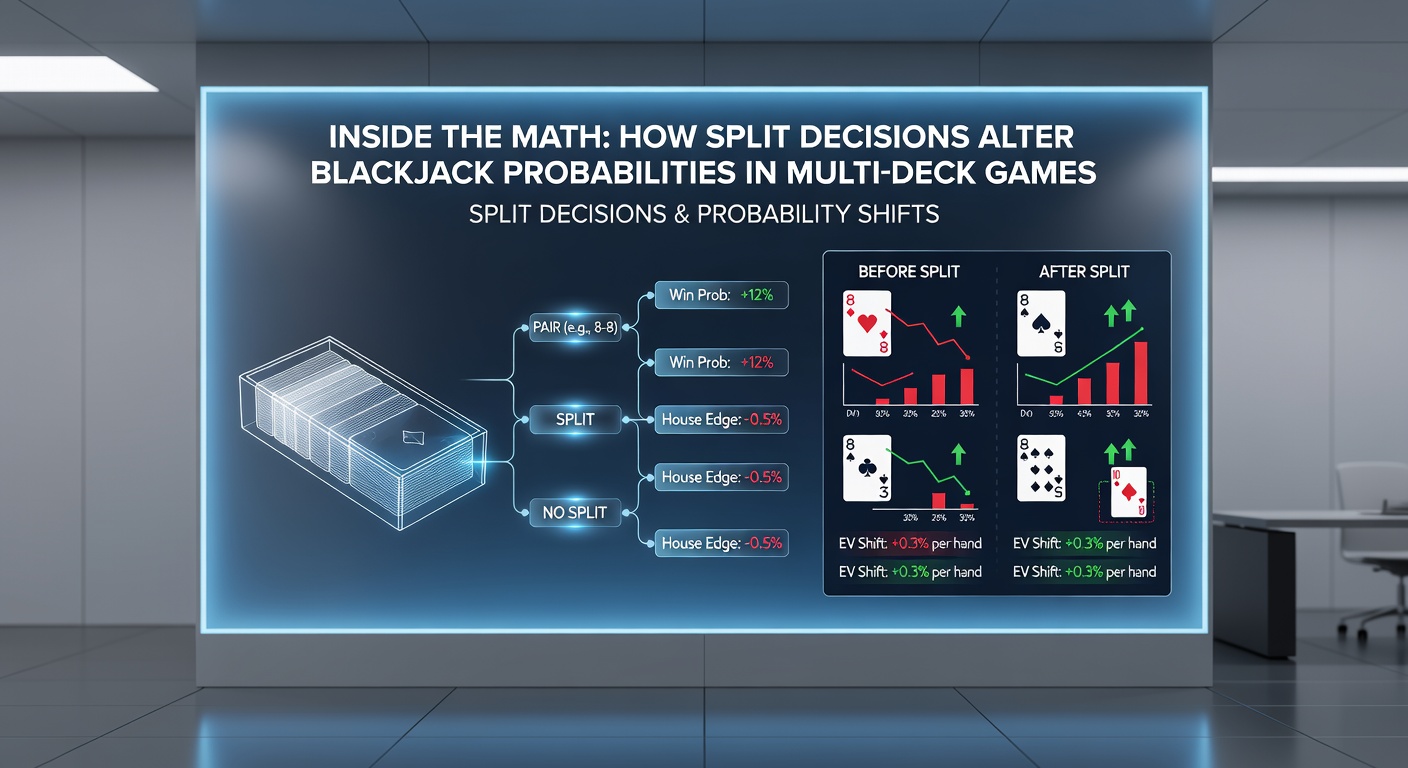
Observers tracking six-deck and eight-deck shoes note that re-splitting pairs further modifies outcomes because additional splits increase the frequency of high-value starting totals such as two eights or two sevens, and rules that cap re-splits at three or four hands therefore limit the player’s ability to exploit those favorable compositions. When re-splitting aces is disallowed the expected value of the initial ace split drops measurably, since the player cannot create multiple soft hands that each carry a strong chance of reaching nineteen or twenty.
Impact on Overall House Edge Calculations
Industry reports compiled by regulatory bodies such as the Alcohol and Gaming Commission of Ontario demonstrate that basic strategy tables calibrated for multi-deck play already embed the optimal split decisions, and deviations from those tables increase the house advantage by fractions of a percent that compound over thousands of hands. Analysts who run Monte Carlo simulations with fixed penetration and dealing rules find that allowing double after split on all pairs reduces the house edge by roughly 0.15 percent in eight-deck games while restricting double after split to certain pairs raises it again.
Because multi-deck shoes dilute card-counting signals, the value of each split decision becomes even more dependent on the exact composition of the remaining cards, yet the baseline probabilities remain anchored to the initial two-card totals and the dealer’s upcard. Players who follow frequency-based strategy adjustments for split opportunities therefore maintain a smaller disadvantage than those who apply single-deck heuristics without recalculating for the diluted effect of removed cards.
Rule Variations and Their Interaction with Splits
European rules that prohibit doubling on split hands alter the expected value of pairs such as six-six against a dealer five, because the player loses the option to improve a twelve into a stronger total after the split occurs. Australian casinos that permit re-splitting up to four hands create a slightly different probability landscape, and comparative studies published by academic gaming research groups show measurable differences in long-run return when those rules are applied consistently across eight-deck shoes.
Conclusion
Split decisions in multi-deck blackjack modify probabilities by converting one wager into two, each with its own independent outcome distribution, and the magnitude of that modification depends on the specific pair, the dealer’s upcard, and the precise rule set governing re-splits and doubling after splits. Accurate enumeration and simulation continue to supply the data that basic strategy charts rely upon, ensuring that players who adhere to those charts achieve the lowest possible house edge permitted by the game’s parameters.