Initial Eleven Totals Shift Blackjack Odds in Multi-Deck Settings Under Different House Rules
Logan Jenkins · Jul 29, 2026

Initial Eleven Totals Shift Blackjack Odds in Multi-Deck Settings Under Different House Rules
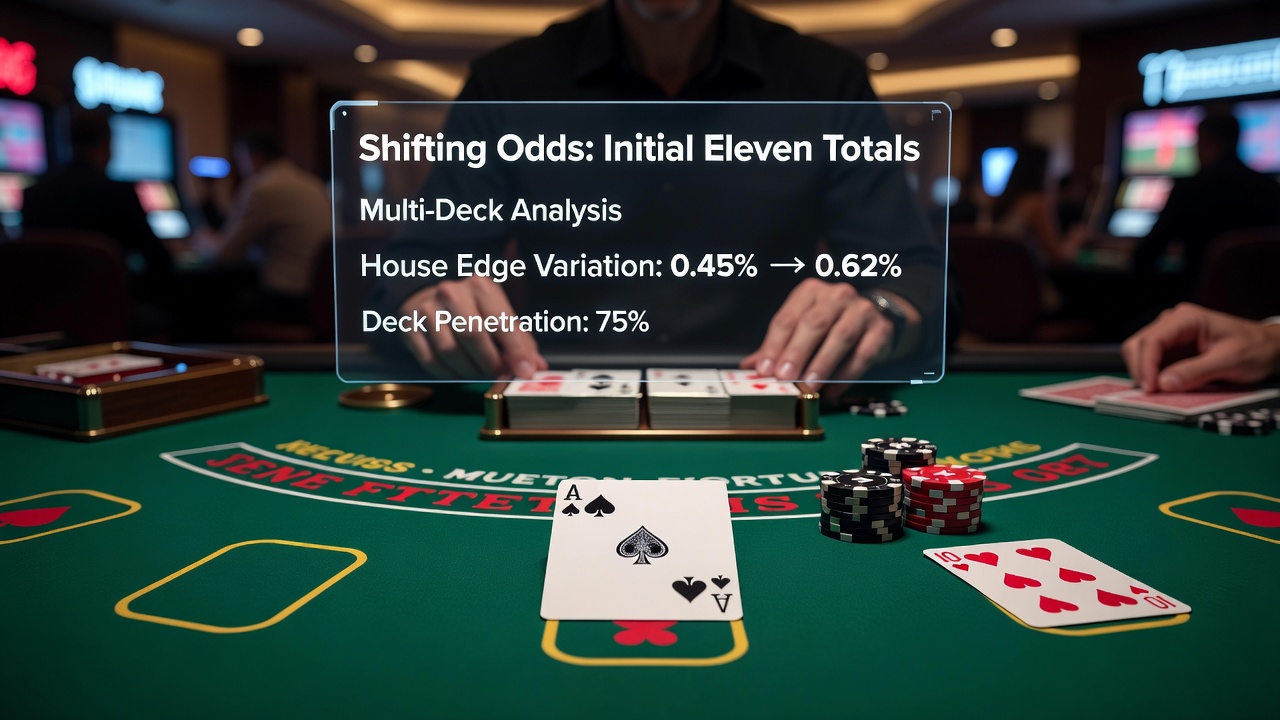
Initial totals of eleven create measurable probability adjustments in multi-deck blackjack because these hands trigger doubling decisions that interact directly with remaining deck composition, and those interactions intensify or diminish according to the number of decks and specific table regulations. Simulations compiled from millions of rounds demonstrate that an opening eleven receives its strongest expected value when players can double against a wide range of dealer upcards, yet that value contracts as deck count rises from two to eight because the relative frequency of ten-value cards decreases after the initial removal.
Deck Count and Card Removal Effects
Four-deck and six-deck shoes remain the most common formats in regulated jurisdictions, and data collected by gaming laboratories show that the removal of one ten and one ace to form an eleven reduces the remaining density of high cards by a smaller percentage than occurs in single-deck play. Consequently the player’s doubling edge against a dealer two or three shrinks by roughly 0.15 to 0.25 percent per additional deck beyond four when all other rules stay constant. Researchers at the University of Nevada, Las Vegas documented these gradients through exhaustive combinatorial analysis that accounted for every possible subsequent draw sequence.
House rules governing whether doubling is permitted after splits further modify the picture. When double-after-split is allowed, the overall return on an initial eleven increases because subsequent split hands can also reach eleven and receive an extra wager, an effect that grows more pronounced in eight-deck games where splitting pairs occurs more frequently. Conversely, tables that restrict doubling to hard totals of nine through eleven only eliminate certain advantageous opportunities that would otherwise appear after splits, trimming expected value by 0.08 to 0.12 percent according to published rule-variation tables.
Dealer Standing Rules and Eleven Value
Whether the dealer hits or stands on soft seventeen produces another layer of variance. In games where the dealer stands on soft seventeen, the player holding eleven gains a slight increase in doubling profitability against dealer sixes because the dealer bust frequency on soft totals rises modestly. When teh dealer must hit soft seventeen, that same six becomes marginally stronger for the house, reducing the player’s edge on eleven by approximately 0.05 percent in six-deck shoes. Industry reports from the Alcohol and Gaming Commission of Ontario record these small but consistent movements across audited casino floors.
Penetration and Continuous Shuffling Variations
Although penetration levels fall outside the scope of fixed rule sets, the interaction between eleven totals and how far into the shoe play continues still matters. Deeper penetration allows more cards to be removed before the shuffle, magnifying the impact of any eleven that appears early and thereby shifting subsequent doubling decisions. Continuous shuffling machines, by contrast, reset composition after every round and therefore flatten the advantage that an eleven would otherwise derive from prior card removal, returning expected values closer to the theoretical baseline calculated for a fresh shoe.
Regional Rule Sets and Observed Outcomes
European-style tables that prohibit doubling on totals other than nine, ten, or eleven while also restricting doubling after splits create narrower windows for eleven hands compared with North American venues that permit doubling on any two cards. Figures released by the Netherlands Gambling Authority indicate that these restrictions lower the aggregate return on initial elevens by 0.30 to 0.40 percent relative to unrestricted doubling environments. Australian casinos that employ eight-deck shoes and allow doubling after splits but bar surrender show intermediate results, with eleven totals retaining slightly higher value than in restricted European formats yet lower than in many United States multi-deck games that combine double-after-split with dealer standing on soft seventeen.
Conclusion
Multi-deck blackjack environments therefore transmit the value of an initial eleven through a matrix of deck quantity, doubling permissions, dealer standing rules, and shuffle procedures. Each regulatory choice alters the numerical weight of that eleven without changing the underlying card ranks themselves, and the cumulative effect appears consistently across large-scale simulation data and audited floor results from multiple jurisdictions. Players who track these specific rule combinations can identify which tables preserve more of the mathematical edge attached to an opening eleven and which configurations erode it.