Eleven's Pivotal Role in Blackjack Doubling Choices
Sofia Schmitt · Aug 26, 2026

Eleven's Pivotal Role in Blackjack Doubling Choices
Blackjack players face a recurring decision point when their hand reaches eleven, since doubling down becomes available under standard rules and the mathematics favor aggressive action against most dealer upcards. Data from probability models shows that eleven carries the highest expected value among all player totals when the option to double exists, because the next card drawn will produce either a strong hand or a bust only in specific scenarios involving tens and aces.
Core Probability Calculations
Basic strategy charts derived from millions of simulated hands place doubling on eleven as the correct move against dealer two through ten, whereas standing or hitting replaces that action only when the dealer shows an ace in games where the dealer hits soft seventeen. Researchers at institutions tracking table game mathematics have calculated that the expected value for doubling eleven versus a dealer six reaches approximately plus 0.41 per unit wagered, while the same play against a dealer ten drops closer to plus 0.10. Those figures shift further when multiple decks enter play or when the dealer stands on all seventeens, because the composition of remaining cards alters the likelihood of drawing a ten-value card to complete the twenty-one.
Live Play Variables
Live casino environments introduce additional layers because physical decks cycle at different rates than digital simulators, and player decisions accumulate across shoes. Observers tracking session data note that the frequency of eleven totals appears once every seven to eight hands on average, creating repeated opportunities where the doubling choice directly influences session variance. When the remaining deck contains a higher proportion of low cards, the probability of receiving a ten-value card on the double decreases slightly, prompting some experienced participants to adjust their wager size downward even though the base strategy remains unchanged.
Impact of Deck Composition
Shifts in remaining card ratios produce measurable changes in the outcome distribution for doubled elevens. A deck rich in tens increases the chance of landing twenty-one after the double, whereas a deck depleted of tens raises the frequency of totals between twelve and sixteen that lose to dealer hands. Studies conducted by gaming research groups indicate these composition effects become statistically significant after roughly one-third of a multi-deck shoe has been dealt, at which point players monitoring the table can identify altered risk profiles without deviating from core doubling rules.
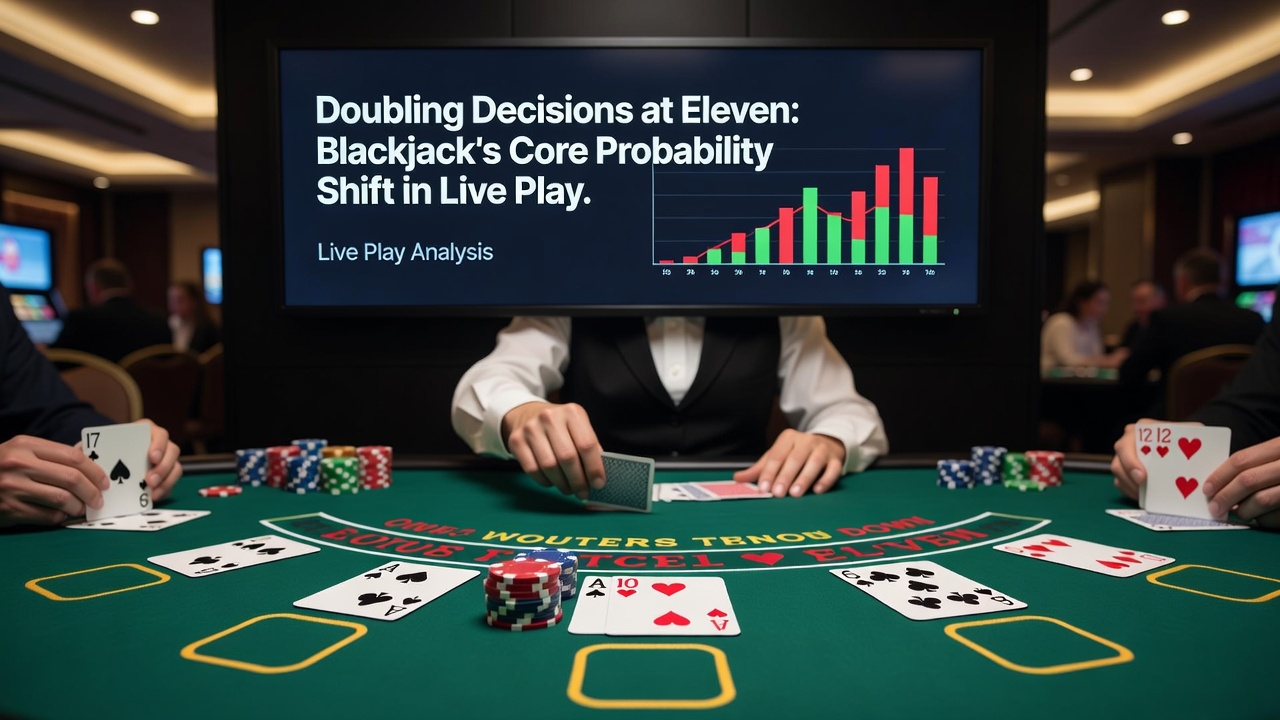
Regulatory updates scheduled for August 2026 in certain jurisdictions may standardize how cardrooms report shoe penetration and table limits, yet the underlying probability mathematics for eleven remain constant across those rule sets. Players who track outcomes across multiple venues often record that doubling decisions executed correctly still produce net positive results over large sample sizes even when house rules vary slightly in payout structures.
Comparative Outcomes Across Rule Sets
Tables operating with six decks versus eight decks show small but consistent differences in the long-run return for repeated elevens. Six-deck games preserve slightly higher volatility because individual card removals carry greater weight, while eight-deck configurations dampen those swings. Industry reports compiled by independent testing laboratories confirm that the doubling edge on eleven stays positive in both formats provided the player follows the established hit-or-stand thresholds for the dealer upcard.
One analysis of live session logs from North American and European properties revealed that participants who doubled eleven against dealer seven through ten achieved win rates within two percentage points of simulated expectations, demonstrating that real-time conditions rarely deviate enough to overturn the base recommendation. Those same logs also highlighted that hesitation on the double decision, often stemming from visible table pressure, reduced overall session returns by measurable margins.
Conclusion
Probability models continue to position eleven as the strongest doubling candidate in blackjack across standard rule variations, with expected values holding steady when players apply consistent strategy. Live play introduces deck-composition effects that become noticeable after substantial cards have been removed, yet the directional guidance for the play remains aligned with published charts. Data gathered from regulatory filings and academic simulations supports the same conclusion that correct execution of this single decision contributes measurably to long-term table performance.