Blackjack Pair Splits: Recalibrating Expected Values in Multi-Deck Games
Sofia Schmitt · Aug 16, 2026
Blackjack Pair Splits: Recalibrating Expected Values in Multi-Deck Games
Pair splitting stands as one of the core decisions players face in blackjack, and its mechanics shift expected values in measurable ways once multiple decks enter the game. Observers note that the option to divide matching cards into two separate hands allows a player to convert one wager into two, yet the house edge recalibrates because each new hand plays independently against the dealer. Research from gaming mathematics shows that the frequency of pair opportunities and the resulting expected value adjustments depend heavily on deck count, since multi-deck shoes dilute card removal effects compared with single-deck formats.
Core Rules Governing Splits in Multi-Deck Play
Standard rules permit a player to split any pair, though casinos impose restrictions on certain combinations such as aces or after a split. In multi-deck shoes, which typically range from six to eight decks, the probability of drawing a ten-value card after splitting aces or eights changes because the remaining deck composition stays closer to the initial distribution. Data indicates that splitting pairs of aces or eights remains advantageous across deck counts, while splitting fours or fives produces negative expected values that grow slightly worse as deck numbers increase. Those who study these patterns find that resplitting options, when allowed, further modify the overall return because additional hands can be created from subsequent pairs.
Expected Value Adjustments After a Split
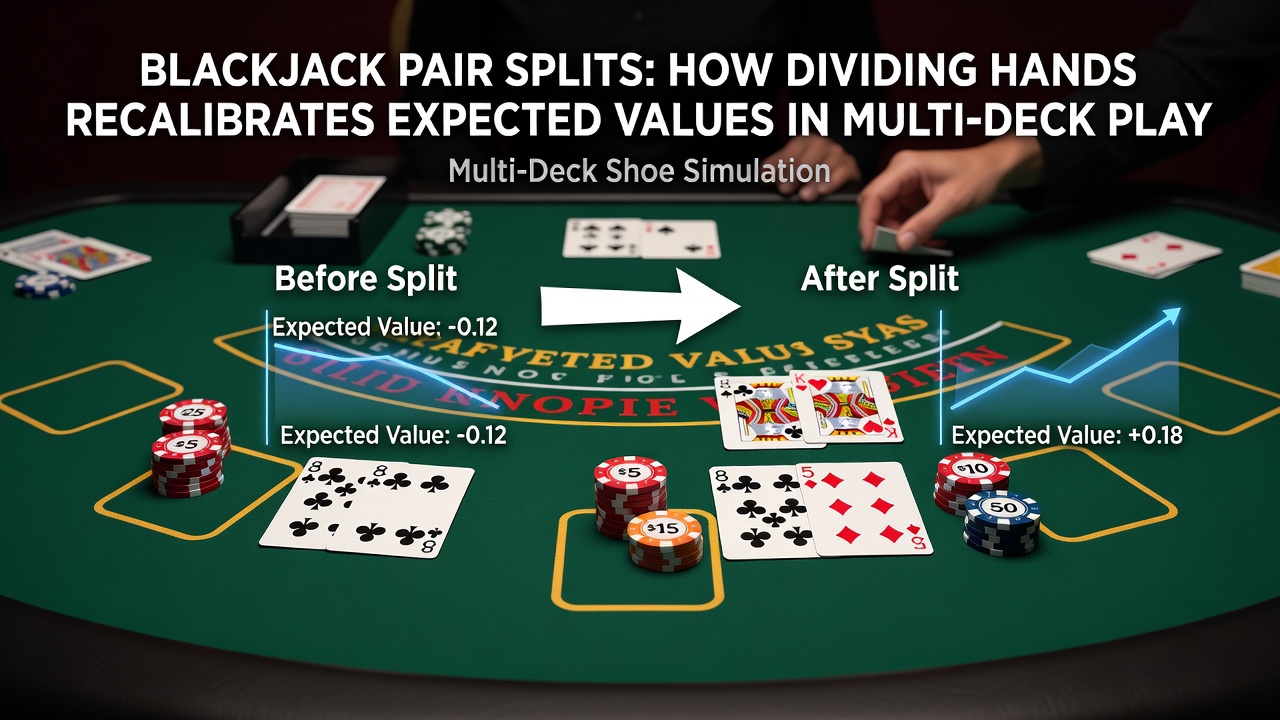
Each split hand carries its own expected value calculation that accounts for the dealer’s upcard and the remaining cards. In an eight-deck shoe the baseline expected value for splitting a pair of sevens against a dealer six sits near a small positive figure when basic strategy charts are followed exactly. Multi-deck environments reduce the swing in expected value that occurs after cards are removed, so the post-split totals align more closely with pre-deal probabilities. Figures from simulation studies reveal that the net expected value gain from splitting pairs of twos and threes against a dealer four or five remains positive yet modest, typically measured in hundredths of a percent per hand.
Impact of Deck Penetration and Card Removal
Deck penetration influences how much splitting opportunities alter long-term returns because deeper penetration exposes more cards and magnifies the effect of any single split. In multi-deck shoes with shallow penetration, the recalibration of expected values stays limited since the composition rarely deviates far from average. Researchers have observed that splits involving ten-value cards rarely occur in practice, yet when they do the resulting expected value shift is pronounced because those cards carry high point totals. The ball remains in the player’s court only when the rules allow doubling after splits, an option that multiplies the benefit of favorable pair divisions such as sixes against a dealer five.
Industry reports compiled by the Nevada Gaming Control Board document how table rules on splitting vary across properties, and these variations directly affect the expected value landscape in multi-deck environments. When resplitting is prohibited, the expected value of certain pairs drops because players lose the chance to create additional advantageous hands. Observers note that European and Australian regulatory frameworks impose different constraints on multi-deck blackjack, producing distinct expected value profiles that players must track separately from North American games.
Strategy Charts and Pair-Specific Outcomes
Basic strategy matrices list precise actions for each pair and dealer upcard, and these matrices shift slightly when the number of decks changes. Splitting nines against a dealer seven yields a positive expected value in six-deck and eight-deck shoes, whereas the same split against a dealer ten carries a negative expectation that deepens with more decks. Data from probability models shows that the cost of deviating from these charts grows in multi-deck play because the house edge sits higher to begin with. Players who follow updated charts derived from computer simulations maintain the recalibrated expected values that splitting is designed to capture.
Regulatory Context and Rule Variations
Changes in permitted split rules appear periodically as operators adjust offerings, and those adjustments alter expected values across multi-deck tables. In regions outside North America, government agencies publish periodic summaries that track how split restrictions influence overall game returns. The Australian Gambling Research Centre has released findings on rule variations that include limits on resplitting and doubling after splits, confirming that such restrictions reduce the player’s expected value by measurable margins in multi-deck formats.
Conclusion
Pair splitting recalibrates expected values in multi-deck blackjack through a combination of independent hand resolutions and altered probabilities tied to remaining deck composition. Simulation data and regulatory summaries together demonstrate that the magnitude of these adjustments depends on specific rules, deck count, and penetration depth. Those who track these factors maintain the precise decisions required to realize the expected value shifts that splitting creates.